
Discover Historical Sites with the Frankfurt History App
In November 2022, the Historisches Museum Frankfurt launched a new digital format: the Frankfurt History App provides information about the National Socialist era in Frankfurt am Main based on the history of selected locations.
In November 2022, the Historisches Museum Frankfurt launched a new digital format: the Frankfurt History App provides information about the National Socialist era in Frankfurt am Main based on the history of selected locations. Interested parties can use an interactive map to find their way around the city and choose from over 1,000 locations according to three themes: Places of Resistance, Places of the “Volksgemeinschaft” and Places of Persecution. Thanks to the app, many of these places are visible in public spaces for the first time.
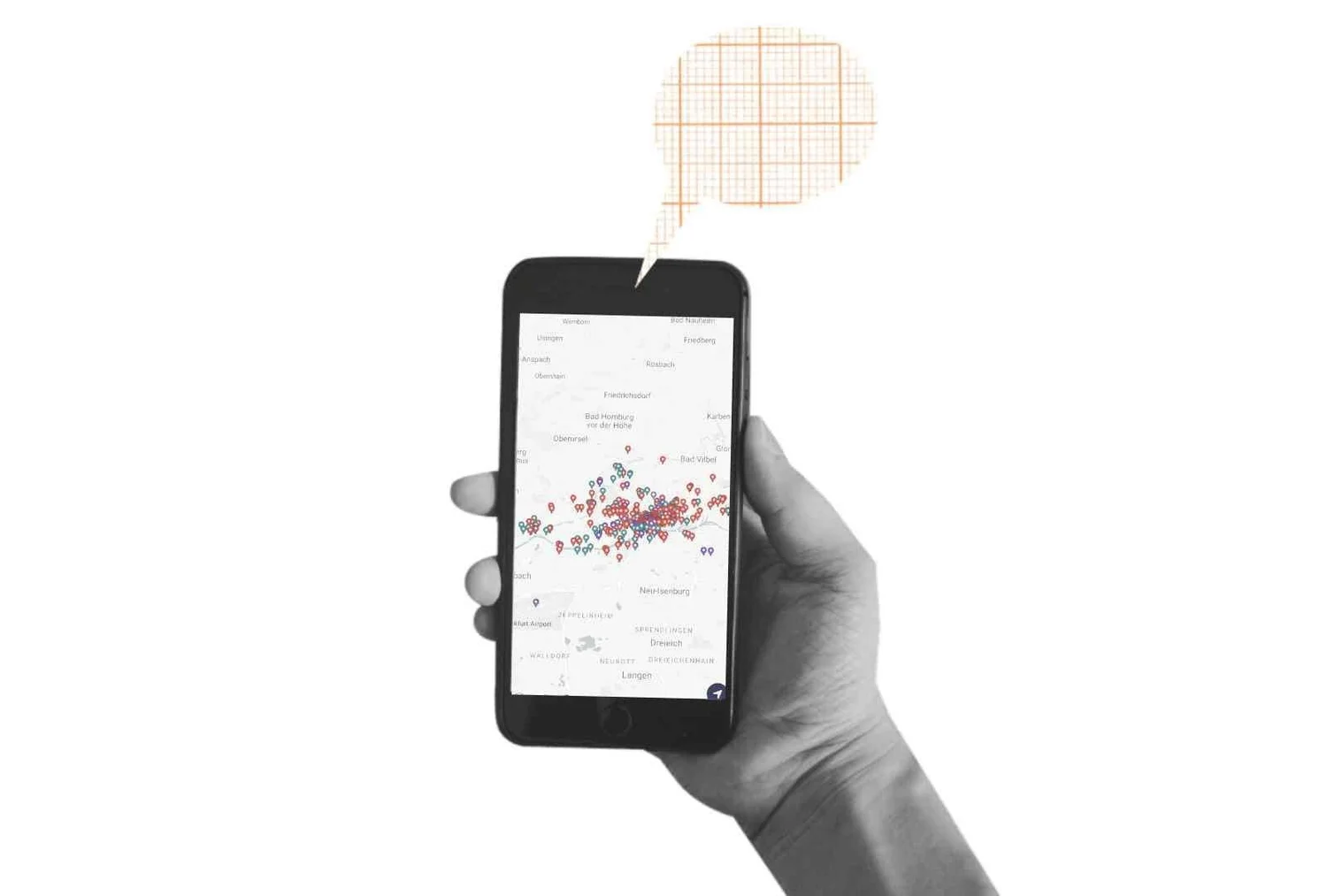
The Frankfurt History App is part of the digital memory platform “Frankfurt and National Socialism”, with which the Historical Museum Frankfurt, the Jewish Museum Frankfurt and the Institute for City History Frankfurt are for the first time bundling extensive knowledge about the city’s history under National Socialism and making it available online.
Who developed the Frankfurt History App?
The Frankfurt History App is managed by the Historisches Museum Frankfurt and offers an open platform for initiatives, associations, museums and archives that want to make their own location-based research publicly accessible.
The project was funded by the Foundation Remembrance, Responsibility and Future (EVZ) and the Federal Ministry of Finance. The app was technically implemented by berlinHistory e.V. based on the model of the berlinHistory app.
I was responsible for the scientific editing and historical research and wrote the texts on places of resistance, places of the “Volksgemeinschaft” and places of persecution. The articles are written in a way that is easy to understand and offer compact information on the history of the places.

What information does the app provide?
The aim of the project is to create a contemporary, mobile and inclusive approach that meets the requirements of a diverse urban society and enables a multi-perspective discussion.
You can choose whether you want to visit specific locations, such as former bunkers, or use the interactive map and geo-based data to see which Nazi sites are located in your area.
The app also provides historical photographs for many of the locations. In this way, historical knowledge becomes concrete thanks to the local reference and, thanks to the numerous biographies that were researched as part of the project, enables an active engagement with the history of National Socialism.
As a second central feature, the app offers city tours, for example on “Remembering Nazi euthanasia at the main cemetery burial ground”. Thirdly, the app provides in-depth information on the persecuted groups and individual biographies.
What can I find out about the history of Frankfurt’s Jews?
The “Places of persecution” section includes Jewish institutions (synagogues, hospitals and schools) as well as private homes and businesses of citizens who were persecuted as Jews.
These include well-known cases such as the patron Dr. Arthur von Weinberg (Villa Buchenrode, Niederräder Landstraße 38) or the collector Maximilian Freiherr von Goldschmidt-Rothschild (Rothschild-Palais, Bockenheimer Landstraße 10), but also previously unknown fates such as that of the Polish Family Felsen (Waldschmidtstraße 99), who were deported to Poland in October 1938.
The events of the November pogroms of 1938 are thematized using the example of the destruction of synagogues and stores as well as places such as the Festhalle, where numerous Jewish men were detained before their deportation.
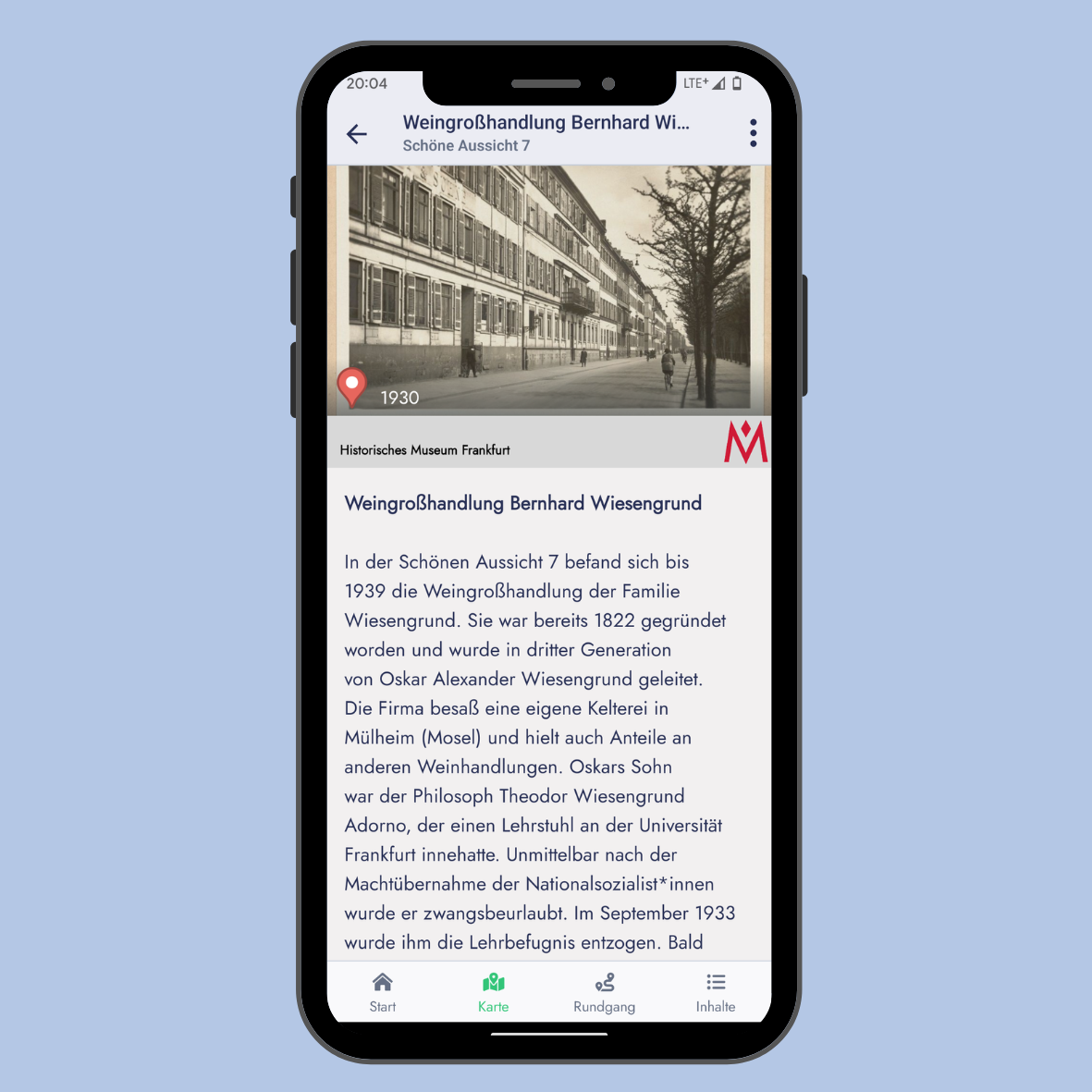
The Wiesengrund family
The Wiesengrund family’s wine wholesale business was located at Schönen Aussicht 7 until 1939. It had already been founded in 1822 and was run by Oskar Alexander Wiesengrund in the third generation. Oskar’s son was the philosopher Theodor Wiesengrund Adorno, who held a chair at the University of Frankfurt.
Immediately after the National Socialists came to power, he was forced to take a leave of absence. In September 1933, his teaching license was revoked. Soon afterwards, he emigrated to England. He lived in Oxford until 1937 and then went to the USA.
During the pogroms on November 9, 1938, members of the SA and SS presumably rioted in the wine shop. They trashed the rooms, demolished the furnishings and destroyed the large wine store. A witness reported that antique clocks and cabinets as well as two oil paintings were destroyed. Three wine barrels, each containing 5,000 liters of wine, were also damaged, resulting in 11,000 liters of wine leaking out.
Oskar and his wife Maria Calvelli-Adorno were in their house in Oberrad at the time. They were attacked in their home and arrested. After his release, Oskar Wiesengrund began to dissolve his company. The wine industry association forced the family to close the business at the beginning of December 1938.
Deprived of their livelihood, the couple tried to obtain an exit permit. This was refused, as they first had to pay the so-called Jewish property tax and the so-called Reich flight tax. The tax office’s demand amounted to just over 110,000 Reichsmarks.
In April 1939, the couple were finally able to emigrate to the USA via Cuba. Oskar died in 1946, Maria in New York in 1952. In the early 1960s, Theodor Wiesengrund Adorno successfully claimed compensation for the enormous financial damage inflicted on his parents.
What do I learn about forced labor?
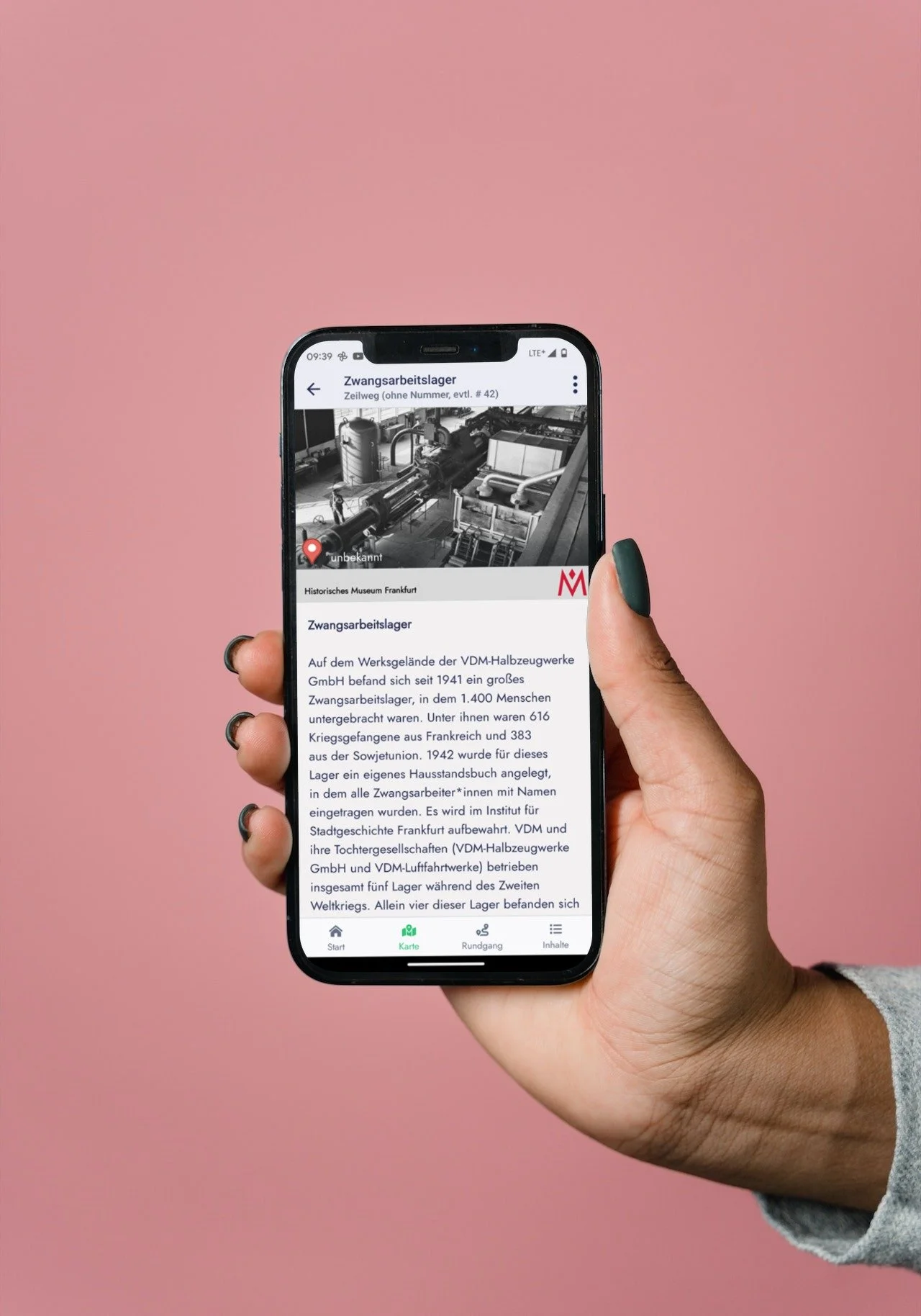
There are currently around 600 references to places in the Frankfurt city area where forced laborers were quartered or employed. The interactive map of the Frankfurt History App makes the extent of the camp system in Frankfurt visible.
Use the app
The Frankfurt History App is available free of charge for Android and iOS. It can be used both on your own and as part of guided tours and school projects.
If you have any questions about research or if you need support - please get in touch.